

The Washington Commanders and Atlanta Falcons delivered an entertaining NFC matchup featuring productive quarterbacks, dangerous playmakers, and several important defensive moments. Both teams found different ways to move the football, with Washington getting strong production from its rushing attack while Atlanta created bigger gains through the air. Discover the Washington Commanders vs Atlanta Falcons match player stats highlight the key performances and crucial moments that ultimately separated the two teams.
Washington Commanders vs Atlanta Falcons Game Overview
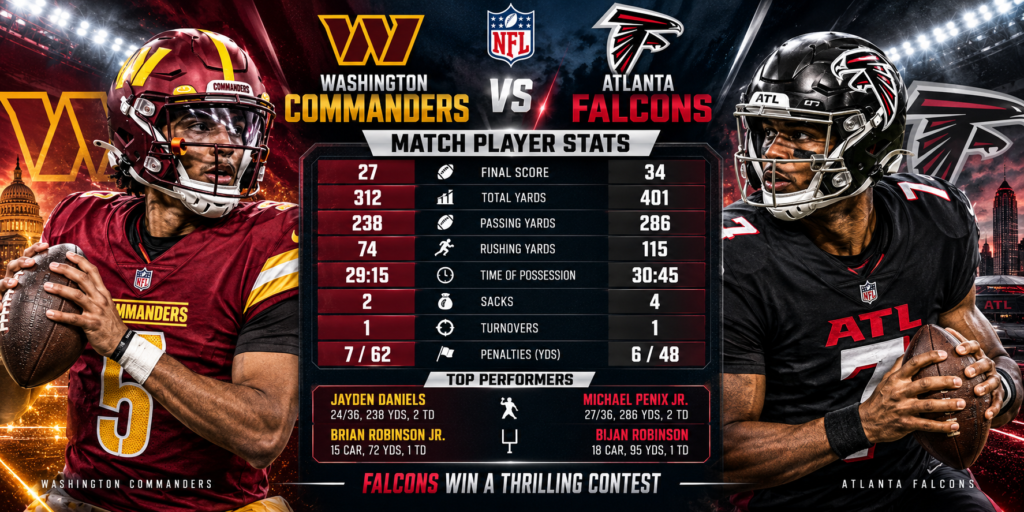
Atlanta defeated Washington 34-27 at Mercedes-Benz Stadium after building an early advantage and protecting it throughout the game. The Falcons scored 10 points in the opening quarter and continued answering whenever Washington reduced the deficit. Although the Commanders stayed within striking distance and produced another push during the fourth quarter, Atlanta maintained control. The seven-point final margin reflected a competitive matchup in which both offenses produced scoring opportunities but Atlanta consistently finished more of its important drives.
Washington Commanders Passing Performance
Marcus Mariota handled Washington’s passing duties and completed 16 of 27 attempts for 156 yards, two touchdowns, and one interception. He also contributed 20 rushing yards on two carries, giving the Commanders another option outside the pocket. Although Washington did not generate many explosive passing plays, Mariota turned several important completions into points. His two touchdown passes helped keep the Commanders competitive, but Atlanta’s ability to limit sustained drives prevented Washington from fully overcoming the early deficit.
Commanders Rushing and Receiving Stats
Washington found encouraging production on the ground, especially from Chris Rodriguez Jr., who rushed seven times for 59 yards. Jacory Croskey-Merritt added 47 yards on seven attempts as the Commanders averaged 6.7 yards per carry as a team. Meanwhile, Deebo Samuel led the receiving group with six catches for 72 yards and a touchdown. Luke McCaffrey also caught a touchdown pass, while Zach Ertz and Jaylin Lane provided additional options within Washington’s shorter passing attack.
Washington Commanders Defensive Performance
Bobby Wagner remained an important presence in the middle of Washington’s defense and finished with 10 total tackles. Jeremy Reaves followed with eight tackles, while Mike Sainristil provided one of Washington’s biggest defensive plays by recording an interception and returning it 23 yards. Frankie Luvu also registered a sack. Despite those individual contributions, the Commanders struggled to consistently slow Atlanta’s passing attack, which produced several explosive gains and helped the Falcons maintain their advantage throughout the afternoon.
Atlanta Falcons Passing Performance
Michael Penix Jr. produced the strongest passing numbers of the matchup, completing 20 of 26 attempts for 313 yards, two touchdowns, and one interception. His accuracy allowed Atlanta to consistently attack Washington’s secondary and create explosive plays downfield. Penix remained efficient while averaging more than 12 yards per completion, helping the Falcons extend drives and create scoring opportunities. His connection with Atlanta’s leading receivers became especially important as Washington attempted to close the scoring gap during the second half.
Falcons Rushing and Receiving Leaders
Bijan Robinson made an impact in multiple areas, rushing 17 times for 75 yards and one touchdown while also recording 106 receiving yards on four catches. Drake London delivered another major performance with eight receptions for 110 yards and a touchdown, giving Atlanta a reliable downfield target. Tyler Allgeier contributed another rushing touchdown, while Kyle Pitts caught a scoring pass. Together, these playmakers gave Penix several dependable options and made Atlanta’s offense difficult for Washington to contain consistently.
Atlanta Falcons Defensive Stats
Atlanta’s defense produced timely stops even though Washington found success running the football. Jessie Bates III finished with seven tackles and remained active throughout the game, while Xavier Watts recorded six tackles and an interception. The Falcons also generated two sacks, putting additional pressure on Washington’s passing attack during important situations. Those defensive plays became especially valuable late in the game when the Commanders attempted to complete their comeback, helping Atlanta protect its advantage and secure the seven-point victory.
Key Team Stats and Third-Down Difference
Atlanta finished with 435 total yards compared with Washington’s 294, while the Falcons held a significant advantage through the air with 313 passing yards against 156. However, one of the biggest differences appeared on third down. Atlanta converted six of 12 opportunities, while Washington converted only one of eight. Those additional conversions helped the Falcons keep drives alive, maintain possession for nearly 34 minutes, and prevent Washington’s offense from getting enough opportunities to completely erase the deficit.
Final Thoughts
The Washington Commanders vs Atlanta Falcons match player stats show how Atlanta’s explosive passing attack and better third-down execution shaped the 34-27 result. Michael Penix Jr., Drake London, and Bijan Robinson produced major numbers for the Falcons, while Marcus Mariota, Chris Rodriguez Jr., Deebo Samuel, and Bobby Wagner delivered notable performances for Washington. Although the Commanders remained competitive, Atlanta generated more total offense and consistently extended drives, giving the Falcons enough control to finish the matchup with the victory.
FAQs:
Who won the Washington Commanders vs Atlanta Falcons game?
The Atlanta Falcons defeated the Washington Commanders 34-27 at Mercedes-Benz Stadium.
Who had the most passing yards?
Michael Penix Jr. led the game with 313 passing yards, completing 20 of 26 attempts with two touchdowns.
Who led the game in rushing yards?
Bijan Robinson led all players with 75 rushing yards on 17 carries and scored one rushing touchdown.
Who had the most receiving yards?
Drake London led the game with 110 receiving yards on eight catches and recorded one touchdown for Atlanta.
What was the key difference between the teams?
Third-down efficiency was a major difference. Atlanta converted six of 12 third downs, while Washington converted only one of eight.
Read More: Chicago Bears vs Minnesota Vikings Match Player Stats